
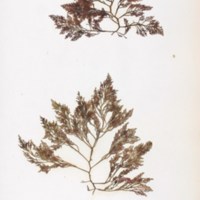
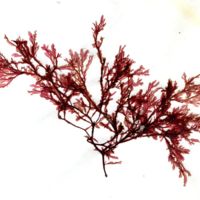
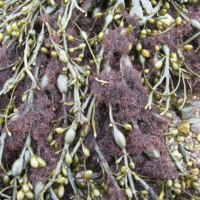
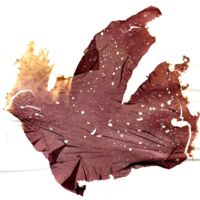
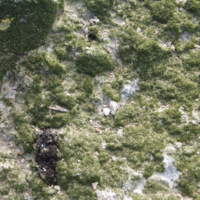
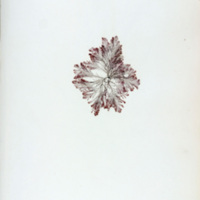
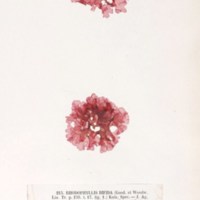
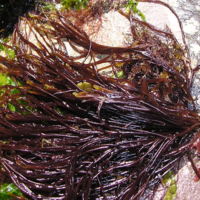
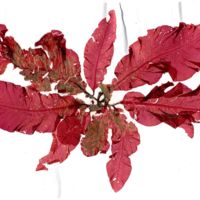
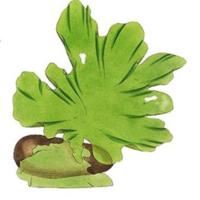
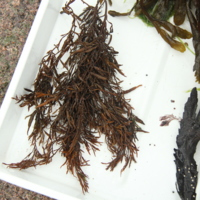
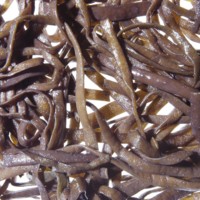
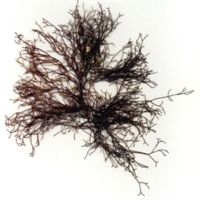
Common Name: Black algae
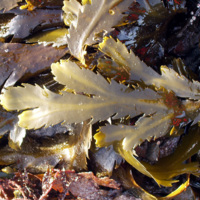
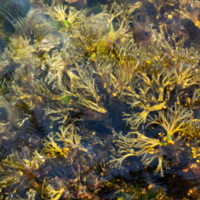
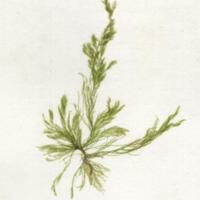
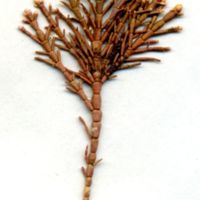
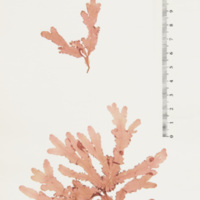
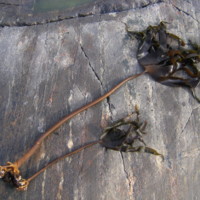
Species Name: Audouinella
Habitats: rock and boulders,cobbles and pebbles,on other plants and animals,wreckage
Sightings: 7
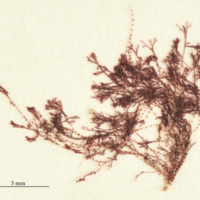
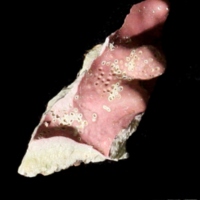
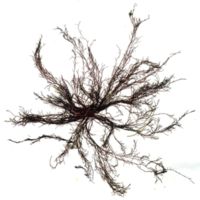
Description: A widespread genus of red algae, found in both marine and freshwater environments and is often tolerant of pollution. Grows in small tufts of red, brown, or black hairlike filaments on any solid surface.
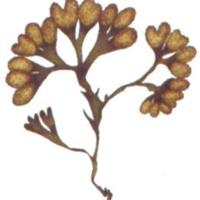
Common Name: Bladder Wrack
Species Name: Fucus vesiculosus
Size: length of body or more 150 cm plus
Sightings: 21
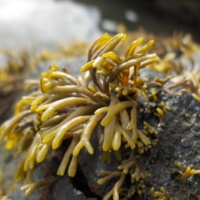
Description: Fucus vesiculosus, known by the common names bladder wrack, black tang, rockweed, bladder fucus, sea oak, black tany, cut weed, dyers fucus, red fucus, and rock wrack is a seaweed found on the coasts of the North Sea, the western Baltic Sea, and the Atlantic and Pacific Oceans. It was the original source of iodine, discovered in 1811, and was used extensively to treat goitre, a swelling of the thyroid gland related to iodine deficiency. https://en.wikipedia.org/wiki/Fucus_vesiculosus
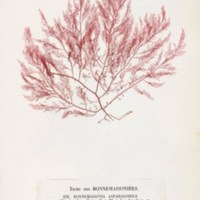
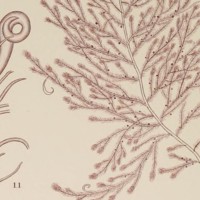
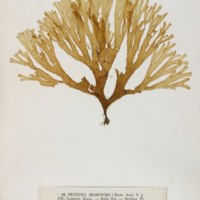
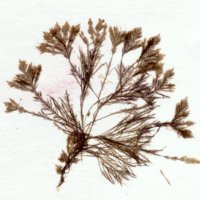
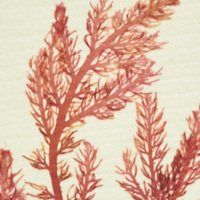
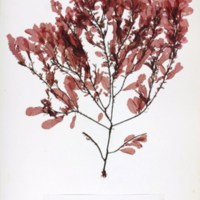
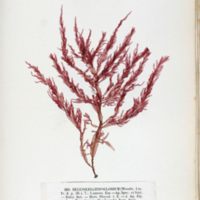
Bonnemaisonia asparagoides by Pierre-Louis Crouan (1798-1871) & Hippolyte-Marie Crouan (1802-1871) is licensed under PDM
Common Name: Bonnemaisonia hamifera
Species Name: Bonnemaisonia hamifera
Size: to first thumb joint 1.5-3 cm
Habitats: rock and boulders,cobbles and pebbles,on other plants and animals
Sightings: 3
Description: A species of red alga in the family Bonnemaisoniaceae. Originally from the Pacific Ocean, it has been introduced into the northeastern Atlantic Ocean, where it is considered invasive on European coasts. It exists in two phases which, at one time, were thought to be different species; a medium-sized feathery form attached to other seaweeds, and a small tufted form known as Trailliella. https://en.wikipedia.org/wiki/Bonnemaisonia_hamifera
Common Name: Carragheen
Species Name: Chondrus crispus
Size: finger tip to thumb joint 11-15 cm
Habitats: rock and boulders,cobbles and pebbles
Depth: 0-10 m,10-25 m
Sightings: 20
Description: Irish moss is not a true moss, it is a species of red algae which grows abundantly along the rocky parts of the Atlantic coast of Europe and North America. In its fresh condition this protist is soft and cartilaginous, varying in color from a greenish-yellow, through red, to a dark purple or purplish-brown. The principal constituent is a mucilaginous body, made of the polysaccharide carrageenan, which constitutes 55% of its dry weight. The organism also consists of nearly 10% dry weight protein and about 15% dry weight mineral matter, and is rich in iodine and sulfur. When softened in water it has a sea-like odour and because of the abundant cell wall polysaccharides it will form a jelly when boiled, containing from 20 to 100 times its weight of water. https://en.wikipedia.org/wiki/Chondrus_crispus
Mastocarpus stellatus by Pierre-Louis Crouan (1798-1871) & Hippolyte-Marie Crouan (1802-1871) is licensed under PDM
Common Name: Cat's puff
Species Name: Mastocarpus stellatus
Size: finger tip to wrist 15-20 cm
Depth: 0-10 m,10-25 m
Sightings: 41
Description: This is a species of red algae closely related to Irish Moss, or Chondrus crispus. It is collected in Ireland and Scotland, together with Chondrus crispus as Irish moss, dried, and sold for cooking and as the basis for a drink reputed to ward off colds and flu. https://en.wikipedia.org/wiki/Mastocarpus_stellatus
Common Name: Ceramium nodulosum
Species Name: Ceramium nodulosum
Size: finger tip to mid forearm 20-30 cm
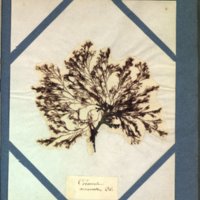
Description: Ceramium nodulosum is a small filamentous branching alga which grows in tufts of erect branches usually fully corticate. The apices of main axes are straight or slightly curled inward at the tips. It attached by a rhizoids with many erect branches. The axes and branches are usually fully corticate and, unlike some other species, it is without spines. https://en.wikipedia.org/wiki/Ceramium_nodulosum
Common Name: Ceramium shuttleworthianum
Species Name: Ceramium shuttleworthianum
Habitats: on other plants and animals
Depth: 0-10 m
Sightings: 20
Description: Ceramium shuttleworthianum is a small alga fundamentally monosiphonous with densely interwoven branches. The cylindrical branches are incompletely corticate. Spines are formed in whorls on the cortical bands near the apices of the branches which are inrolled near the tips. The spines have a multicellular base merging with the cortical bands cells and are 2 to 3 cells long. Only 3 other species in the British Isles have spines which help in identification: Ceramium echionotum, Ceramium ciliatum, Ceramium gaditanum. on the rocks, mussels and in rock pools in the littoral. https://en.wikipedia.org/wiki/Ceramium_shuttleworthianum
Description: Algae of this genus are made up of macroscopic filaments of cylindrical cells. The genus is characterized by its unbranched filaments, making it distinctive; its closest relatives are branching species of the genus Cladophora. https://en.wikipedia.org/wiki/Chaetomorpha
Common Name: Channel Wrack
Species Name: Pelvetia canaliculata
Size: finger tip to thumb joint 11-15 cm
Sightings: 13
Description: Pelvetia canaliculata, channel wrack, is a very common brown alga (Phaeophyceae) found on the rocks of the upper shores of Europe. It is the only species remaining in the monotypic genus Pelvetia. In 1999, the other members of this genus were reclassified as Silvetia due to differences of oogonium structure and of nucleic acid sequences of the rDNA. https://en.wikipedia.org/wiki/Pelvetia
Common Name: Cladophora
Species Name: Cladophora
Size: to first thumb joint 1.5-3 cm
Description: Cladophora is a genus of reticulated filamentous Ulvophyceae (green algae). The genus Cladophora contains many species that are very hard to tell apart and classify, mainly because of the great variation in their appearances, which is affected by habitat, age and environmental conditions. Unlike Spirogyra the filaments of Cladophora branch and do not undergo conjugation. There are two multicellular stages in its life cycle - a haploid gametophyte and a diploid sporophyte - which look highly similar. https://en.wikipedia.org/wiki/Cladophora
Common Name: Coral Weed
Species Name: Corallina officinalis
Size: finger tip to thumb joint 11-15 cm
Habitats: rock and boulders
Depth: 0-10 m
Sightings: 32
Description: Corallina officinalis is a calcareous red seaweed which grows in the lower and mid-littoral zones on rocky shores. It forms calcium carbonate deposits within its cells which serve to strengthen the thallus. These white deposits cause the seaweed to appear pink in colour, with white patches where the calcium carbonate is particularly concentrated, such as at the growing tips. The calcium carbonate makes it unpalatable to most rocky shore grazers. https://en.wikipedia.org/wiki/Corallina_officinalis
Description: Laminaria hyperborea is a species of large brown alga, a kelp in the family Laminariaceae, also known by the common names of tangle and cuvie. It is found in the sublittoral zone of the northern Atlantic Ocean. A variety, Laminaria hyperborea f. cucullata is known from more wave sheltered areas in Scandinavia. https://en.wikipedia.org/wiki/Laminaria_hyperborea
Cutleria multifida by Pierre-Louis Crouan (1798-1871) & Hippolyte-Marie Crouan (1802-1871) is licensed under PDM
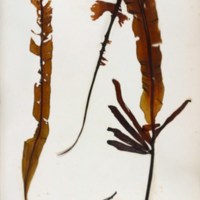
Alaria esculenta by Pierre-Louis Crouan (1798-1871) & Hippolyte-Marie Crouan (1802-1871) is licensed under PDM
Common Name: Dabberlocks
Species Name: Alaria esculenta
Size: finger tip to 3/4 arm length 40-50 cm
Habitats: rock and boulders,wreckage
Depth: 0-10 m
Sightings: 32
Description: Alaria esculenta is an edible seaweed, also known as dabberlocks or badderlocks, or winged kelp. It is a traditional food along the coasts of the far north Atlantic Ocean. It may be eaten fresh or cooked in Greenland, Iceland, Scotland and Ireland. It is the only one of twelve species of Alaria to occur in both Ireland and in Great Britain. https://en.wikipedia.org/wiki/Alaria_esculenta
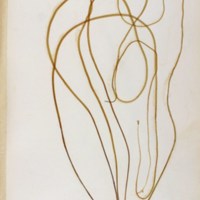
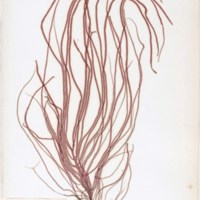
Chorda filum by Pierre-Louis Crouan (1798-1871) & Hippolyte-Marie Crouan (1802-1871) is licensed under PDM
Common Name: Dead Man's Rope
Species Name: Chorda filum
Habitats: sand and gravel,mud
Depth: 10-25 m
Sightings: 1
Description: A species of brown algae in the genus Chorda. It is widespread in the temperate waters of the northern hemisphere. The species also has numerous other common names related to its physical appearance. Names include mermaid's tresses, cat's gut, bootlace weed, seatwine, and mermaid's fishing line. https://en.wikipedia.org/wiki/Chorda_filum
Dictyota dichotoma by Pierre-Louis Crouan (1798-1871) & Hippolyte-Marie Crouan (1802-1871) is licensed under PDM
Common Name: Dulse
Species Name: Palmaria palmata
Size: finger tip to shoulder 40-60 cm
Habitats: rock and boulders,on other plants and animals
Sightings: 24
Description: Palmaria palmata, also called dulse, dillisk, dilsk, red dulse, sea lettuce flakes, or creathnach, is a red alga (Rhodophyta) previously referred to as Rhodymenia palmata. It grows on the northern coasts of the Atlantic and Pacific Oceans. It is a well-known snack food. In Iceland, where it is known as söl, it has been an important source of dietary fiber throughout the centuries. https://en.wikipedia.org/wiki/Palmaria_palmata
Common Name: Dumontia contorta
Species Name: Dumontia contorta
Size: finger tip to wrist 15-20 cm
Habitats: rock and boulders,cobbles and pebbles
Sightings: 22
Description: The fronds branch irregularly and sparingly. The branches are hollow, soft and twisted, dark reddish brown in colour which bleach towards the tips, they clearly taper at their junction. The plants are dioecious with spermatangia, carposporangia, and tetrasporangia. https://en.wikipedia.org/wiki/Dumontia_contorta
Common Name: Egg Wrack
Species Name: Ascophyllum nodosum
Size: length of body or more 150 cm plus
Sightings: 9
Description: Ascophyllum nodosum is a large, common cold water seaweed or brown alga (Phaeophyceae) in the family Fucaceae, being the only species in the genus Ascophyllum. It is a seaweed that only grows in the northern Atlantic Ocean, also known in localities as feamainn bhuí, rockweed, Norwegian kelp, knotted kelp, knotted wrack or egg wrack. It is common on the north-western coast of Europe (from Svalbard to Portugal) including east Greenland and the north-eastern coast of North America, its range further south of these latitudes being limited by warmer ocean waters. https://en.wikipedia.org/wiki/Ascophyllum
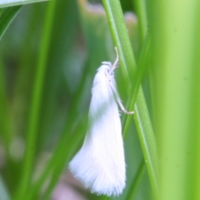
Description: Elachista is a genus of gelechioid moths described by Georg Friedrich Treitschke in 1833. It is the type genus of the grass-miner moth family (Elachistidae). This family is sometimes (in particular in older sources) circumscribed very loosely, including for example the Agonoxenidae and Ethmiidae which seem to be quite distinct among the Gelechioidea, as well as other lineages which are widely held to be closer to Oecophora than to Elachista and are thus placed in the concealer moth family Oecophoridae here. https://en.wikipedia.org/wiki/Elachista
Common Name: Gut weed
Species Name: Ulva intestinalis
Size: finger tip to thumb joint 11-15 cm
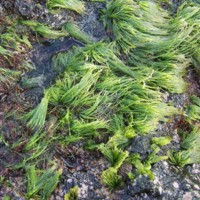
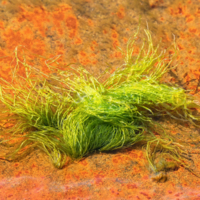
Description: Ulva intestinalis is a green alga in the family Ulvaceae, known by the common names sea lettuce, gutweed and grass kelp. Until they were reclassified by genetic work completed in the early 2000s, the tubular members of the sea lettuce genus Ulva were placed in the genus Enteromorpha. https://en.wikipedia.org/wiki/Ulva_intestinalis
Hildenbrandia rubra by Pierre-Louis Crouan (1798-1871) & Hippolyte-Marie Crouan (1802-1871) is licensed under PDM
Description: Laminaria is a genus of 31 species of brown algae commonly called "kelp". Some species are also referred to as tangle. This economically important genus is characterized by long, leathery laminae and relatively large size. Some species are referred to by the common name Devil's apron, due to their shape, or sea colander, due to the perforations present on the lamina. It is found in the north Atlantic Ocean and the northern Pacific Ocean at depths from 8 to 30 m (26 to 98 ft) (exceptionally to 120 m (390 ft) in the warmer waters of the Mediterranean Sea and off Brazil). Laminaria form a habitat for many fish and invertebrates. https://en.wikipedia.org/wiki/Laminaria
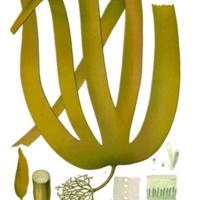
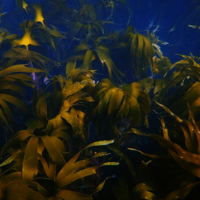
Common Name: Kelp
Description: Kelps are large brown algae seaweeds that make up the order Laminariales. Despite its appearance, kelp is not a plant; it is a heterokont. They are known for their high growth rate—the genera Macrocystis and Nereocystis can grow as fast as half a metre a day, ultimately reaching 30 to 80 metres (100 to 260 ft). (https://en.wikipedia.org/wiki/Kelp)
Laurencia hybrida by Pierre-Louis Crouan (1798-1871) & Hippolyte-Marie Crouan (1802-1871) is licensed under PDM
Common Name: Lithothamnion glaciale
Species Name: Lithothamnion glaciale
Size: to first thumb joint 1.5-3 cm
Habitats: sand and gravel
Depth: 0-10 m
Sightings: 2
Common Name: Lobster horns
Species Name: Polysiphonia
Size: finger tip to mid forearm 20-30 cm
Habitats: rock and boulders,on other plants and animals
Sightings: 7
Description: Polysiphonia is a genus of filamentous red algae with about 19 species on the coasts of the British Isles and about 200 species worldwide, including Crete in Greece, Antarctica and Greenland. Its members are known by a number of common names. It is in the order Ceramiales and family Rhodomelaceae. https://en.wikipedia.org/wiki/Polysiphonia
Common Name: Membranoptera alata
Species Name: Membranoptera alata
Size: finger tip to wrist 15-20 cm
Habitats: rock and boulders,on other plants and animals
Depth: 0-10 m,10-25 m
Sightings: 26
Description: Membranoptera alata is a small red marine alga growing to a length of no more than 20 cm. Its fronds are up to 2.4 mm wide and monostromatic, that is formed of a thin layer of cells, narrow and branching in one plane. A midrib runs along the center of the branches with fine microscopic veins from the midrib to the margins. The tips of the young branches are asymmetric, incurved and blunt, not pointed. https://en.wikipedia.org/wiki/Membranoptera_alata
Nitophyllum punctatum by Pierre-Louis Crouan (1798-1871) & Hippolyte-Marie Crouan (1802-1871) is licensed under PDM
Laminaria digitata by Pierre-Louis Crouan (1798-1871) & Hippolyte-Marie Crouan (1802-1871) is licensed under PDM
Common Name: Oarweed
Species Name: Laminaria digitata
Size: length of body or more 150 cm plus
Sightings: 27
Description: Laminaria digitata is a large brown alga in the family Laminariaceae, also known by the common name Oarweed. It is found in the sublittoral zone of the northern Atlantic Ocean. https://en.wikipedia.org/wiki/Laminaria_digitata
Common Name: Pepper dulse
Species Name: Laurencia pinnatifida
Size: finger length 3-11 cm
Description: A small marine alga which grows in tufts with branches to a length of 8 cm from a discoid holdfast which produces of stolons for further support. The fronds are flattened with a medulla of thick cells covered by a cortex of 2 layers. The branches are alternate, flattened and branching in one plane from the sides one or two times. The axes show a small terminal groove at the apex. https://en.wikipedia.org/wiki/Osmundea_pinnatifida
Petalonia fascia by Pierre-Louis Crouan (1798-1871) & Hippolyte-Marie Crouan (1802-1871) is licensed under PDM
Common Name: Phyllophora crispa
Species Name: Phyllophora crispa
Size: finger tip to thumb joint 11-15 cm
Habitats: rock and boulders
Depth: 25 m
Sightings: 3
Description: Phyllophora crispa is a medium-sized marine red alga. It grows from a short terete stipe. The frond is firm bright red in colour and with flattened parallel sides. It branches dichotomously the tips being rounded. It is cartilaginous with the medulla, the internal parts composed of large compact cells enclosed in two to four layers of smaller cells. https://en.wikipedia.org/wiki/Phyllophora_crispa
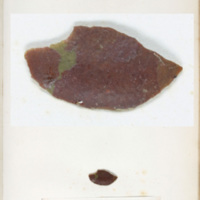
Common Name: Pink Encrusting Algae
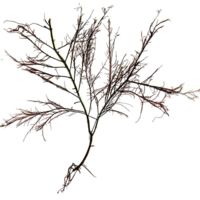
Polysiphonia fucoides by Pierre-Louis Crouan (1798-1871) & Hippolyte-Marie Crouan (1802-1871) is licensed under PDM
Common Name: Polysiphonia fucoides
Species Name: Polysiphonia fucoides
Size: finger tip to wrist 15-20 cm
Description: Polysiphonia fucoides is a relatively small seaweed. It grows as branched, cylindrical tufts reaching 30 cm or more in length. The branches are themselves densely branched, the main branch usually distinct. It is attached by matted branches which produce rhizoids. The branches are composed of a central axes of cells surrounded by 11 to 21 pericentral cells all of the same length. Cortication is generally absent but may be formed on the major branches near the holdfast, with the cells growing down in grooves between the pericentral cells. https://en.wikipedia.org/wiki/Polysiphonia_fucoides
Common Name: Polysiphonia lanosa
Species Name: Polysiphonia lanosa
Size: finger length 3-11 cm
Description: Polysiphonia lanosa (Vertebrata lanosa; Polysiphonia fastigiata) is a common species of the red algae (Rhodophyta) often to be found growing on Ascophyllum nodosum. https://en.wikipedia.org/wiki/Polysiphonia_lanosa
Common Name: Porphyra purpurea
Species Name: Porphyra purpurea
Size: finger tip to elbow
Habitats: rock and boulders,cobbles and pebbles,on other plants and animals
Depth: 0-10 m
Description: A medium sized marine red algae which is formed of a single membranous layer of cells which form a blade attached by a disk holdfast.
Common Name: Prasiola stipitata
Species Name: Prasiola stipitata
Size: thumbnail-less than 1.5 cm
Sightings: 6
Description: This alga grows to no more than 1 centimeter long, is fan shaped with a distinct stipe. The vegetative frond is monostromatic. The cells in the blade are arranged in packets of 4 or more. In colour the fronds are dark green. https://en.wikipedia.org/wiki/Prasiola_stipitata
Pterosiphonia parasitica by Pierre-Louis Crouan (1798-1871) & Hippolyte-Marie Crouan (1802-1871) is licensed under PDM
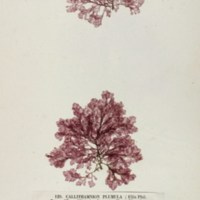
Pterothamnion plumula by Pierre-Louis Crouan (1798-1871) & Hippolyte-Marie Crouan (1802-1871) is licensed under PDM
Common Name: Purple Laver
Species Name: Porphyra umbilicalis
Size: finger tip to wrist 15-20 cm
Habitats: rock and boulders,cobbles and pebbles
Depth: 0-10 m,10-25 m
Sightings: 25
Description: A small red algae which appears green when young and purplish-red when grown. An edible seaweed type used to make many different dishes, with a taste similar to olives and oysters.
Common Name: Red Comb Weed
Species Name: Plocamium cartilagineum
Size: finger length 3-11 cm
Habitats: rock and boulders
Depth: 25 m
Sightings: 16
Description: Plocamium cartilagineum is an erect red alga growing to 10 cm in length. The main axes is flattened with regular flattened branches on both sides. The branches are long and short alternately, the short ones on one side are opposite the longer on the other side. These longer branches bear two or three short curved branches in series, comb-like. The plants are fully corticated. This branching pattern is similar to Plocamium lyngyanum and Plocamium maggsiae the other European species which have only recently been distinguished. https://en.wikipedia.org/wiki/Plocamium_cartilagineum
Common Name: Red Rags
Species Name: Dilsea carnosa
Size: finger tip to wrist 15-20 cm
Habitats: rock and boulders,wreckage
Depth: 0-10 m,10-25 m
Sightings: 3
Description: This large alga is dark red, flattened and somewhat leathery. It grows from a small discoid base. The mature blade has a compact medulla enclosed within a cortex of rounded cells inwards and outwards of close radial filaments of about 6 cells. It grows from a discoid holdfast with a short stipe. https://en.wikipedia.org/wiki/Dilsea_carnosa
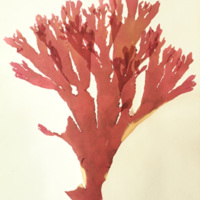
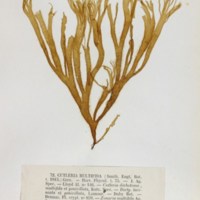
Rhodophyllis divaricata by Pierre-Louis Crouan (1798-1871) & Hippolyte-Marie Crouan (1802-1871) is licensed under PDM
Common Name: Scytosiphon lomentaria
Species Name: Scytosiphon lomentaria
Habitats: cobbles and pebbles,on other plants and animals
Sightings: 6
Description: Scytosiphon lomentaria is a littoral brown seaweed with an irregularly lobed many filamentous form. It is a member of the Phaeophyta in the order Dictyosiphonales and grows attached to shells and stones in rock-pools and in near-shore waters. The attachment to the substrate is by a small disc shaped holdfast. https://en.wikipedia.org/wiki/Scytosiphon_lomentaria
Common Name: Sea Beech
Species Name: Delesseria sanguinea
Size: finger tip to wrist 15-20 cm
Habitats: rock and boulders,on other plants and animals,wreckage
Depth: 0-10 m,10-25 m
Sightings: 12
Description: Delesseria sanguinea is a common and bright red perennial alga with flat leaf-like red blades rising from a discoid holdfast. The blades are monostromatic, that is composed of a layers of single cells, and can grow to 25 cm long. Each blade rises from a cylindrical stipe, the stalk-like part, which branches only at near the base. Each blade may 8 cm wide and show a clear midrib with lateral veins. The tips of the blades are rounded. https://en.wikipedia.org/wiki/Delesseria_sanguinea
Description: The sea lettuces comprise the genus Ulva, a group of edible green algae that is widely distributed along the coasts of the world's oceans. The type species within the genus Ulva is Ulva lactuca, lactuca being Latin for "lettuce". The genus also includes the species previously classified under the genus Enteromorpha, the former members of which are known under the common name green nori. https://en.wikipedia.org/wiki/Sea_lettuce
Common Name: Sea Oak
Species Name: Halidrys siliquosa
Size: finger tip to shoulder 40-60 cm
Sightings: 11
Description: Halidrys siliquosa is a large brown alga growing to a length of 120 centimetres (47 in). The fronds are somewhat flattened, tough and leathery. They and less than 1 cm broad. The branches occur alternately arranged in one plane. Air bladders occur and are oblong and pointed. The plants are attached by a discoid holdfast. https://en.wikipedia.org/wiki/Halidrys_siliquosa
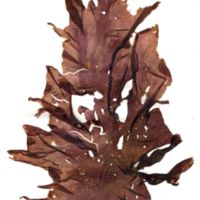
Phycodrys_rubens by Pierre-Louis Crouan (1798-1871) & Hippolyte-Marie Crouan (1802-1871) is licensed under PDM
Common Name: Sea Oak
Species Name: Phycodrys rubens
Size: finger tip to mid forearm 20-30 cm
Habitats: rock and boulders
Depth: 25 m
Sightings: 21
Description: This red seaweed has jagged oak leaf shaped fonds.
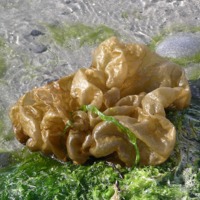
Description: Leathesia difformis, is a synonym for Leathesia marina (Lyngbye) Decaisne, 1842, commonly known as the sea cauliflower and the sea potato. It is a species of littoral brown algae in the class Phaeophyceae and the order Ectocarpales which is commonly attached to other seaweeds and sometimes rocks. When young, the organism is solid but as it matures it becomes hollow and somewhat convoluted and has the appearance of a small leathery brown bag about the same size as a tennis ball. The texture is rubbery and the outer surface smooth. https://en.wikipedia.org/wiki/Leathesia_difformis
Common Name: Serrated Wrack
Species Name: Fucus serratus
Size: length of body or more 150 cm plus
Sightings: 26
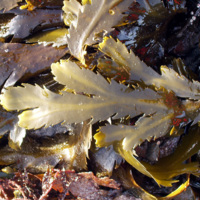
Description: F. serratus is a robust alga, olive-brown in colour and similar to Fucus vesiculosus and Fucus spiralis. It grows from a discoid holdfast up to 180 centimetres (6 ft) long. The fronds are flat, about 2 cm (0.8 in) wide, bifurcating, and up to 1 m (3 ft 3 in) long including a short stipe. It branches irregularly and dichotomously. The flattened blade has a distinct midrib and is readily distinguished from related taxa by the serrated edge of the fronds. It does not have air vesicles, such as are found in F. vesiculosus, nor is it spirally twisted like F. spiralis. Male and female receptacles are on different plants. https://en.wikipedia.org/wiki/Fucus_serratus
Common Name: Spiral Wrack
Species Name: Fucus spiralis
Size: finger tip to mid forearm 20-30 cm
Habitats: rock and boulders
Sightings: 9
Description: Fucus spiralis is a species of seaweed, a brown alga (Heterokontophyta, Phaeophyceae), living on the littoral shore of the Atlantic coasts of Europe and North America. It has the common names of spiral wrack and flat wrack. https://en.wikipedia.org/wiki/Fucus_spiralis
Phyllophora pseudoceranoides by Pierre-Louis Crouan (1798-1871) & Hippolyte-Marie Crouan (1802-1871) is licensed under PDM
Common Name: Stalked leaf bearer
Species Name: Phyllophora pseudoceranoides
Size: finger length 3-11 cm
Habitats: rock and boulders
Depth: 25 m
Sightings: 3
Description: It is a small leaf algae which is generally flattened and fan shaped, growing from a discoid holdfast forming a terete stipe with flattened branches dividing dichotomously as a blade with rounded apices. The medulla, the inner parts of the frond, is composed of large thick walled cells, closely packed become smaller towards the cortex. https://en.wikipedia.org/wiki/Phyllophora_pseudoceranoides
Desmarestia_viridis by Pierre-Louis Crouan (1798-1871) & Hippolyte-Marie Crouan (1802-1871) is licensed under PDM
Common Name: Stringy Acid Kelp
Species Name: Desmarestia viridis
Size: length of body or more 150 cm plus
Sightings: 3
Description: This brown marine algae grows solitary to 2 m long. It is densely branched. The branches are terete and grow from a bulbous holdfast. The main axis is distinct and grows is 1 mm wide, the final branches fine and hair-like. https://en.wikipedia.org/wiki/Desmarestia_viridis
Common Name: Sugar Kelp
Species Name: Laminaria saccharina
Size: length of body or more 150 cm plus
Habitats: rock and boulders
Description: Saccharina latissima is a brown algae (class Phaeophyceae), of the family Laminariaceae. It is known by the common name sugar kelp, and also sea belt and Devil's apron, due to its shape. It is found in the north east Atlantic Ocean, the Pacific Ocean and the Barents Sea south to Galicia in Spain. It is not found in the Bay of Biscay but is common round the coasts of the British Isles. The species is found at sheltered rocky seabeds. https://en.wikipedia.org/wiki/Saccharina_latissima
Common Name: Thong Weed
Species Name: Himanthalia elongata
Size: length of body or more 150 cm plus
Sightings: 13
Description: Himanthalia elongata is a brown alga in the order Fucales, also known by the common names thongweed, sea thong and sea spaghetti. It is found in the north east Atlantic Ocean and the North Sea. According to the World Register of Marine Species, Himanthalia elongata is the only member of its genus, Himanthalia Lyngbye, 1819 and the only member of its family, Himanthaliaceae (Kjellman) De Toni, 1891. https://en.wikipedia.org/wiki/Himanthalia_elongata
Hypoglossum hypoglossoides by Pierre-Louis Crouan (1798-1871) & Hippolyte-Marie Crouan (1802-1871) is licensed under PDM
Common Name: Under Tongue Weed
Species Name: Hypoglossum hypoglossoides
Size: finger tip to mid forearm 20-30 cm
Sightings: 4
Description: Hypoglossum hypoglossoides is a small red alga growing as monostromatic blades. The lateral branches grow as blades which, like the primary blade, has a midrib. All the blades have a lanceolate or acute apices. All the blades lack lateral veins. https://en.wikipedia.org/wiki/Hypoglossum_hypoglossoides
Common Name: Wire Weed
Species Name: Ahnfeltia plicata
Size: finger tip to thumb joint 11-15 cm
Habitats: rock and boulders
Depth: 10-25 m
Sightings: 5
Description: The holdfast is up to 2.5 cm (1 in) wide and composed of a thin layer encrusting the rock substrate. The frond's reddish-black colour results from the red pigments phycoerythrin and phycocyanin. Their colour is so intense that it masks the presence of other pigments, chlorophyll a and beta-Carotene. Some unique xanthophylls are also present in this seaweed. The Wire weed could be confused with Cordylecladia erecta but that species is less common and is thicker with more rigid, regularly branched fronds.
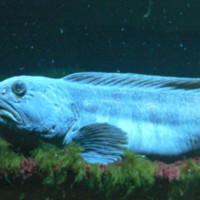
Common Name: Wolffish
Species Name: Anarhichas lupus
Size: length of body or more 150 cm plus
Depth: 25 m
Sightings: 11
Description: The wolffish, also known as sea wolves, are a family, Anarhichadidae, of perciform fish. They are native to cold waters of the northern Atlantic and Pacific oceans, where they live on the continental shelf and slope, to depths of about 600 m (2,000 ft). They are bottom-feeders, eating hard-shelled invertebrates such as clams, echinoderms, and crustaceans, which they crush with their strong canine and molar teeth. The longest species, Anarrhichthys ocellatus, grows to more than 2 m (6.6 ft) in length. https://en.wikipedia.org/wiki/Anarhichadidae
Description: Brongniartella byssoides is a small brownish-red marine alga. It consists of tufts of erect axes. The erect axes are polysiphonous, that is each axes is composed of axial cells each covered with periaxial cells without cortication. All the branches produce secondary lateral branches which produce the ultimate final monosiphonous ramuli. The mature thallus pyramidal in shape. The plants are attacked by rhizoids with disc-like bases. https://en.wikipedia.org/wiki/Brongniartella_byssoides
Description: Ceramium is a genus of red algae (or Rhodophyta). It is a large genus with at least 15 species in the British Isles. All species of Ceramium are small algae growing to no more than 30 cm (12 in) in length. They consist of a terete monosiphonous axis of cells surrounded by smaller cells forming a cortex. In most species this a continuous cortex enclosing the axis, in others the cortical cells are arranged only in nodes at the junction of cells of the axes. The tips of the branches grow in a pincer-like manner. https://en.wikipedia.org/wiki/Ceramium
Description: A type of Ceramium.
Description: Chaetomorpha linum is a species of green algae in the family Cladophoraceae. Chaetomorpha linum and Chaetomorpha aerea are considered by some authors to be conspecific. This is not accepted by other authorities. https://en.wikipedia.org/wiki/Chaetomorpha_linum
Description: Fucus is a genus of brown algae found in the intertidal zones of rocky seashores almost throughout the world. https://en.wikipedia.org/wiki/Fucus
Description: Lithothamnion is a genus of thalloid red alga comprising 103 species. Its members are known by a number of common names. The monomerous, crustose thalli are composed of a single system of filaments which grow close to the underlying surface. Lithothamnion reproduces by means of multiporate conceptacles. https://en.wikipedia.org/wiki/Lithothamnion
Description: The thallus of this species is dark red in colour, grows to 30 cm long and is perennial. It is attached by a discoid holdfast and grows in tufts, erect, firm and cartilaginous. All the axes and branches are compressed or flat with an inconspicuous central midrib. The lateral branches are short and are produced alternately from near the base, they are deeply toothed. https://en.wikipedia.org/wiki/Odonthalia_dentata
Description: Phyllophora is a genus of red algae in the family Phyllophoraceae.
Description: It grows from a small holdfast and a short stipe up to 3 mm long which spreads to a small flat blade which is oblong or with parallel sides. It branches once or twice. The fronds are formed with a compact medulla of large cells with a cortex of small cells in 2 or 3 layers. Phyllophora traillii is named for George William Traill a Scottish phycologist and mineralogist. https://en.wikipedia.org/wiki/Phyllophora_traillii
Description: Phymatolithon is a genus of non geniculate coralline red algae, known from the UK and Australia. It is encrusting, flat, and unbranched; it has tetrasporangia and bisporangia borne in multiporate conceptacles. Some of its cells bear small holes in the middle; this distinctive thallus texture is termed a "Leptophytum-type" thallus surface, and has been posited as a taxonomically informative character. It periodically sloughs off its epithallus, reducing its overgrowth by algae by as much as 50% compared to bare rock. https://en.wikipedia.org/wiki/Phymatolithon
Description: A calcareous seaweed which is not easily recognised as a plant.
Description: Polysiphonia brodiei (Dillwyn) Sprengel, now generally spelled "brodiaei", as it is named after James Brodie is a species of red algae in the Rhodophyta. It grows in tufts up to 36 cm long. https://en.wikipedia.org/wiki/Polysiphonia_brodiei